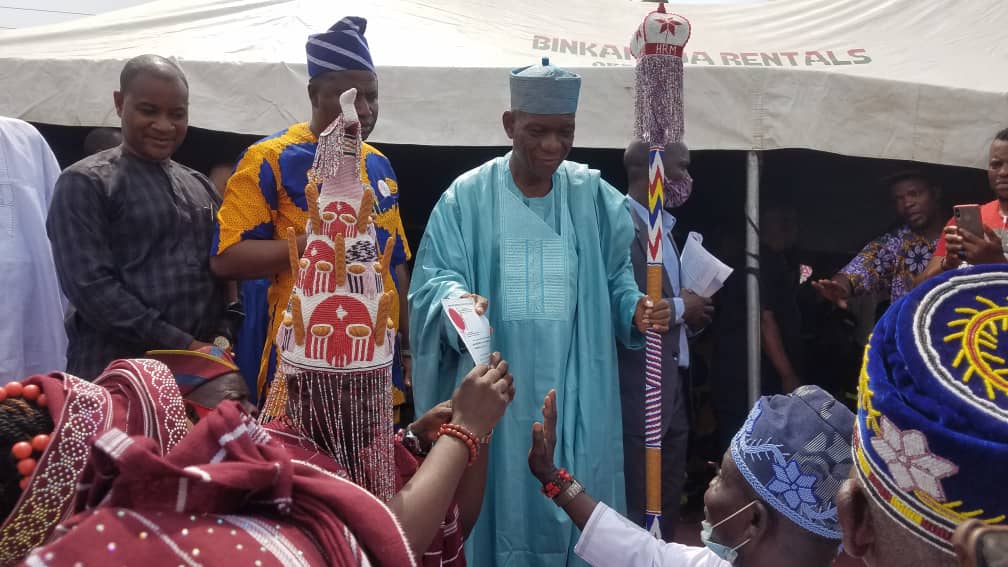
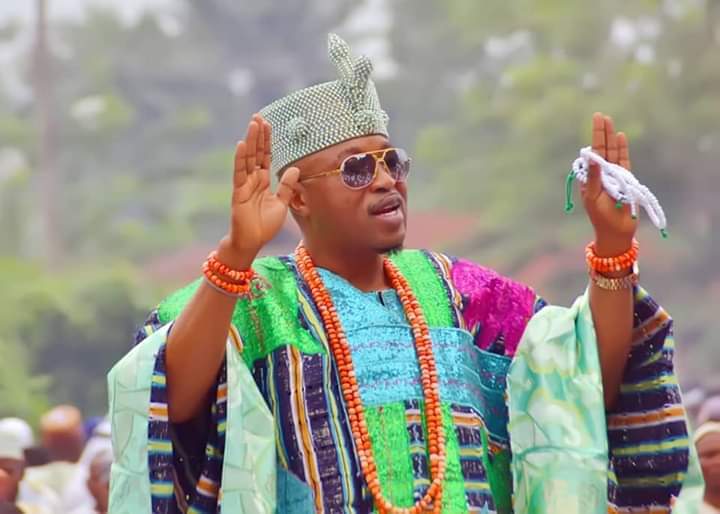
Governor Seyi Makinde implemented the judgement delivered by Justice Taiwo on 5th Oct 2018 reinstating Oba Sunday Bolawaye as the Onilala of Lanlate after years of legal tussle.
Presenting the staff of Office to the reinstated Onilala of Lanlate Oba Sunday Oladejo, Governor Seyi Makinde stated that the presentation is a further confirmation as the father of all in the ancient town.
While the wearing of beaded Crown was performed by the Alaafin of Oyo Oba Lamidi Adeyemi III, who was represented by Iba Saamu of Oyo, Iba Lagunna of Oyo Town accompanied by other royal fathers and Chiefs.
Governor Seyi Makinde urged the Monarch to bring his rich experience and influence to bear in the promotion of rich yoruba culture and peace in his domain.
Governor Seyi Makinde who was represented by the Commissioner for Local governments and Chieftaincy matters Chief Bayo Lawal stated that the present administration is seriously committed to seeking ways and means of enhancing the dignity and honour of Obas and Chiefs.
Earlier in his remarks the Caretaker Chairman of Ibarapa East Local government Olugbenga Obalowo said the administration in the local government will continue to give respect to royal institutions. In his remarks the newly Crowned Monarch Onilala of Lanlate His Royal Majesty Oba Sunday Bolawaye Oladejo stated that the stool will continue to champion peace,togetherness, and Coperation in Ibarapaland. Some Sons and daughters of Lanlate including the lawmaker representing Ibarapa East / Ido federal Constituency in the house of Representatives and others from Ibarapaland present at the presentation of Staff of Office and Beaded Crown laud the present administration in Oyo state for allowing judiciary to be the last hope of the common man by implementing the Judgment concerning Onilala Stool.
The Oyo State Police Command has confirmed the arrest of members of the Odua Peoples Congress – OPC, and assured of diligent prosecution of suspected criminal in the state.
CSP. Fadeyi Olugbenga, the Public Relations Officer, Oyo state command, made this known in a statement on Sunday.
The command said that any person or group of persons from any region or tribe that has been found culpable to have committed any criminal act(s) in the State would not be spared, but would be arrested and dealt with according to extant laws.
The statement read: “We would like to inform the general public that at about 0900 hrs of date (7th March 2021), information was received that a group of persons, (later found out to be members of the Odua Peoples Congress – OPC), had invaded Kajola community in Ibarapa axis of the State.
“The invasion was reportedly aimed at arresting one Wakili, a Fulani by tribe, who is alleged to be the sponsor and mastermind of various criminal attacks against the people/farmers of Yoruba origin in the community.
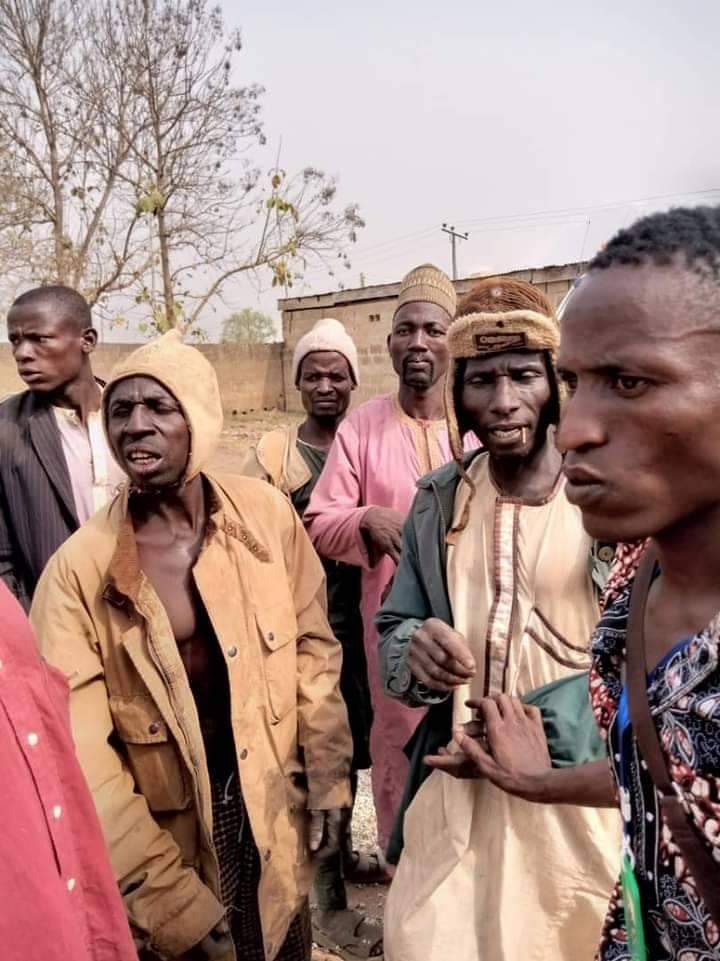
“The State Commissioner of Police has quickly moved into action and preliminary findings revealed that some OPC members went to Kajola community in Ibarapa North Local government Area of Oyo State. While there, the house of the Wakili in question was set ablaze, while a female (the identity of who is yet to be ascertained) was burnt in the fire and Wakili (about 75 years old and blind) with two (2) other persons were picked up. The three (3) of them are presently in the custody of the Police. The Commissioner of Police has directed that Wakili (due to his frail appearance and state of health), be moved to the Hospital, while others are being interrogated. Others being interrogated are the OPC members, involved in arson and murder.
“Meanwhile, the Oyo State Police Command wishes to inform the general public that any person or group of persons from any region or tribe that has been found culpable to have committed any criminal act(s) in the State would not be spared, but would be arrested and dealt with according to extant laws.
“Therefore, it is worthy of note that the good people of Oyo State and the general public should be rest assured that the officers and men in the Command would not derelict in its duty to bring to book criminal elements arrested for any infringement on the laws of the land, as adequate security measures has been emplaced against anything untoward while soliciting credible information from members of the public to enable the Police and other Security Agencies clampdown on crime and criminality in the State. In conclusion, anybody that has any case against Iskilu Wakili should report it to the State Criminal Investigation Department, (CID) Iyaganku Ibadan for discreet Investigation.”
The Lagos State Police Command has arrested 56 suspected cultists and armed robbers in the Ikorodu and Ibeju Lekki areas of the state.
Among those arrested are two wives of cultists and a man who was alleged of killing over 22 people in the state.
The Lagos Police Public Relations Officer, Olumuyiwa Adejobi, made this known in a statement titled, ‘Lagos will be hot for cultists, criminals – CP’, on Sunday.
The statement quoted the Commissioner of Police in Lagos State,Hakeem Odumosu, as re-echoing the command’s readiness to tackle and decimate criminals in the state while confirming “the arrest of 50 suspected armed robbers and cultists at Imota, Igbokuta, Adamo and Emure in Ikorodu area of the state during a sting operation carried out by the Commissioner’s of Police Strike Force between Friday 5th and Sunday 7th March, 2021.
“The 38 male and 12 female suspects include Oladunni Abiodun, m, 20; Dosumu Oluwaseun, 22; Segun Adelaja, 29; Gbamila Iyabo, f, 26; wife of the Number 1 of Aye Confraternity in Igbokuta, arrested with one pump action loaded with 8 rounds of cartridges; Salisu Islamiyat, f, 29, wife of the Number 1 of Aye Confraternity in Emure arrested with a locally-made pistol with some live cartridges; Abiodun Abbey, m, aka Oju Ogunle, alleged to have killed more than 22 people in Ikorodu area, and 44 others.
Some members of the Oodua Peoples Congress who arrested the alleged notorious herder at Ayete, Iskilu Wakili were said to have been rounded up by the Oyo State Police Command.
Wakili was arrested by members of OPC and some Vigilante Groups. The arrest of Wakili came just a week after his second-in-command, Isiaka Muhammadu, was arrested with four others.
A source from the OPC told newsmen that their colleagues who arrested Wakili had, in turn, been arrested by the Police and were being queried why they arrested Wakili.
“I heard that some OPC men had been arrested by the police in connection with Wakili’s arrest. It is curious.”
A resident of Igangan, Saliu Abdulkadri, said, “many of us had thought that the end had come to the oppression and constant anguish to which the farmers were subjected. Little did we know that the woes had just begun.”
He said, after the eviction of Seriki, Wakili had allegedly intensified his atrocities in the area daring anyone to arrest him.
Sources said Wakili relied on deadly weapons, native powers as well as federal might.
It was learnt that Wakili had recently shot at an emissary that was said to have been sent by Baale Odomofin, the traditional ruler in control of Gbangbangere, Konko, Dagbere, Kajola, Magbeje, and other hamlets in Ayete, who were sent to serve him a quit notice.
A source from the OPC said “I learnt that four OPC members were arrested by the Police in connection with Waikili’s arrest. I cannot speak authoritatively about the arrest because my men were not involved.”
Some Yoruba leaders who are beating the drum of war and sponsoring crisis in Nigeria for selfish political reason will not end well.
The Oluwo of Iwo Oba AbdulRasheed Akanbi who stated this on Saturday, said all the hues and cries on security challenges in the Southwest region was about the 2023 presidential election.
He said, “Those who are singing discordant tune are doing so because of personal aggrandisement. We know some Yoruba leaders who are calling for war for political reason. It is all about 2023 presidency. Because they feel someone wants to become President and they don’t want him.
It is because they know that the next president of this country will be Yoruba and they don’t want that to happen. The person they are accusing has not even come out to say that he wants to be President so why all hatred?”
The monarch said some Yoruba leaders who were fanning ember of discord and calling for war should desist in the interest of national unity.
“Some bad elders are sponsoring crisis in Yoruba land because of political reason and self aggrandisement. I will not allow war to come to Yoruba land or Nigeria. Stop beating the drum of war or you will not end well.
“you see, people have to be very careful because we will never support anyone that wants to disrupt the peace of the land. Anyone who wants to destroy the Southwest and particular, Lagos state will not end well” Oluwo lamented.
Oba Akanbi also warned against ethnic profiling, saying criminals were in all tribe and they should be treated as one.
“This thing is not about Fulani or Yoruba. It is political. Some people are sponsoring crimes to destroy Nigeria. Crime doesn’t have a tribe. Prosecute criminals and tried them in court, not a tribe” he said.
Oluwo emphasised the need for government to provide intervention programme which will aim at educating herders on modern day ranching to avert clashing with farmers.
He also advised Fulani herders to assist government and security agencies to fish out criminals in their folds.
“We want the Fulani also to fish out the criminals among them. You Fulani people should also come and live in the town, don’t live in the bush again. Let us know all of you.
“The Fulani community should talk more to the government to teach you modern way of ranching. Open gracing is no longer fashionable in 21st century. We know you are used to it but you have to change to the modern ways.
“There must be an intervention programme from the government to educate Fulani on modern way of ranching. Some of you should engage in pastoral business for herders to buy feeds from you. This is how you will not be having problems with famers”, Oluwo stated.
Members of the Oodua Peoples Congress have arrested the notorious Fulani warlord terrorising Oyo community, Iskilu Wakilu.
Kehinde Aderemi, Special Assistant on Media to Aare Ona Kakanfo of Yorubaland, Gani Adams Adams, confirmed this to The PUNCH on Sunday.
“Yes, he has been arrested by our team. You will get details later,” he said on the telephone.
Meanwhile, the pan-Yoruba socio-cultural organization, Afenifere has commended OPC for the arrest of Wakilu.
The National Publicity Secretary of Afenifere, Yinka Odumakin, in a statement on Sunday, said, “Afenifere gives tremendous commendation to OPC under Iba Gani Adams for the arrest of iskilu Wakilu, a Fulani bandit who has been spreading terror on ou people in Igboho area and the Nigerian Police and other security agencies unable to do anything about him.
“The early morning peaceful arrest confirms our position on how effective local initiative can do well in homeland security.
“We were not shocked that but for the intervention by the leadership in Oyo State, the Police would have gone after the OPC boys instead of taking the criminal from them and do the needful.
“Nigeria is going nowhere with a security network that shuns federalism.”
Well done, OPC.’
OPC had on February 27 arrested the second-in-command to the alleged dreaded kidnapper, one Isiaka Muhammadu.
The news last week that the Economic and Financial Crimes Commission (EFCC) had begun a probe into the finances of former governor of Lagos State and All Progressives Congress (EFCC) strongman, Bola Ahmed Tinubu, literally shattered the Nigerian political airwaves. In the news, the EFCC reportedly wrote a letter to the Code of Conduct Bureau (CCB) asking it to furnish the commission with details of Tinubu’s assets declaration form. Dated November 6, 2020, marked CR/3000/EFCC/LS/Vol4/322 and signed by its then Zonal Head, Abdulrasheed Bawa who is now the EFCC chairman, media reports had it that the renewed probe was predicated on petitions written against Tinubu under the chairmanship of Ibrahim Magu which he swept under the rug. Chief among the allegations in the petition was that of Alpha Beta, a company allegedly owned by the ex-governor. Tinubu’s alleged ownership of sundry properties and concerns, among a plethora others, donned the said petition.
By “shattering political airwaves,” I meant that the politically naïve were taken aback by this turn of events. In virtually all the states of Nigeria, the periodic rat race for 2023 has begun and only the fittest can survive the heat. We are entering Nigerian politicians’ own masquerade festival season and its insignia of festivity – multiple coloured dresses – is beginning to appear. Anyone in possession of a political binocular microscope which can see through the recess of the fetid minds of the Nigerian politician would predict with oracular certainty that Tinubu’s mess has begun and can only witness a metastasis.
In the mind of the Nigerian politician, all that is foul is fair. A Nigerian politician’s desperation for power is so pervasive that it can be likened to that of a man driven to the point of killing his mother and roping his father for it. Scruples, ethos and dignity are easily sacrificed in political permutations while, all things taken into consideration, it will seem that those whose hearts are carapace-hard and incapable of empathy and sympathy operate at the highest echelon of political decision-making. Ancient ethos of requiting good for good easily becomes a sacrificial lamb when the Nigerian politician’s political calculus and permutations are in full swing.
It was all the above pieced together, added to the austere national good that inheres in it, which formed part of the rationale for the previous pieces I wrote on Tinubu’s touted aspiration to become the president of Nigeria. With an understanding of the mindset of those who make political decisions in Nigeria, it was not difficult to appear like a Nostradamus on the projected travails of a man who, in close to 22 years of Nigeria’s Fourth Republic, has gradually grown to become a power octopod.
At the risk of sounding patronizing, no 1999 Class of politician has acquired Tinubu-type huge political muscles, majesty and political bravura in Nigeria. The culmination of his grits manifested when, in 2015, he literally single-handedly ensured the emergence of severally-scorned-at-the-polls Muhammadu Buhari as president of Nigeria. A source once told me that, on the announcement of Buhari as president, Tinubu was so literally intoxicated at the outcome that he announced to some group of people that what that meant was not only that all corporations and institutions of Nigeria were in his pocket but that Nigeria herself had thenceforth began to oscillate right on top of his thumb. As vast as he is about the temperature of power and power politics in Nigeria, never did it occur to him to factor into the equation the understanding that, requiting good with blood-curdling wickedness was the genetic component of Nigerian political chess-gaming.
During this time, the most potent weapon for Tinubu to achieve whatever he wanted as a political aspiration in a larger Nigeria was to, like Chief Obafemi Awolowo, tighten his hold on his western Nigerian base, become Awo-ly consequential therein and use this hold to secure a negotiation on administering the rest of Nigeria. Unfortunately for him, gradually, he lost grips of his base, so much that, if an election is conducted in Yorubaland today, Tinubu can scarcely win two states to his side.
Corruption in Nigeria is indeed hydra-headed. Many analysts have imputed a genetic drift into it. Scholars have also submitted that Nigeria would continue to be the laughing stock of the world, even as it witnesses regression in all departments of statehood, until that national leeching spirit is exorcised. With this as the background, asking the EFCC not to do its constitutionally-assigned duty of smoking out malefactors, will tantamount to seeking nourishment and flourish for evil to continue its imperious reign in Nigeria. However, the modus operandi of this EFCC searchlight on Tinubu appears very shroudy and bears every imprimatur of politics. Exchanged in hushed tones and whispers, information that Tinubu’s hold on its erstwhile chairman Ibrahim Magu, is akin to that of a Mandarin, has been oscillating in the public domain for a while now. It was even said that, aware of their incestuous dalliance, Buhari and his power apparatchik deliberately refused to confirm the Maiduguri-born cop’s tenure as substantive chairman of the commission as a way of exhibiting their disdain for Tinubu. Nigeria’s Attorney General, Abubakar Malami, is the legal anvil through whom the legal aspect of the equation is baked and served. So when the EFCC boss began to go through his long-winding travails that eventually led to his exit, those who were knowledgeable about power equations said that it was the first omen that the scaly hands of the Nigerian power establishment was on its way to getting the Lagos political principality. There was no way they could get Tinubu without first demolishing his hold which Magu approximated and an anti-corruption czar who is the establishment’s lickspittle surely appears a fitting icing on the cake to dismantle the Tinubu stronghold.
If the highly touted familial relationship between Malami and Bawa, newly appointed EFCC chairman, has any modicum of truth in it, then it may be justifiably said that Bawa’s main assignment could be to achieve the Buhari click’s end result of smoking out Tinubu. The desperation to push through the candidacy of the 40-year old young man and the apparent frenetic drive to adjust his eligibility cadre are pointers to this effort. Bawa had just spent 16 years in the commission. As a starter, what structured public service job would anybody do for just 16 years and would have acquired enough depth to sit at its zenith? A last-minute shoring up of Bawa’s service cadre was curiously, and with cheetah speed, done before his appearance at the senate. An implementation of the Justice Ayo Salami panel’s alleged recommendation that police officers should be stopped from heading the commission was also haphazardly pushed through. The question is, is the white paper of the panel’s report out? If it is not out, was it not putting the cart before the horse to implement a recommendation before its white paper is out? The last we heard of the Salami-led judicial panel of enquiry report was that President Buhari had set up a four-man committee to review it.
Also in the news was that the committee would be saddled with producing the White Paper on the probe report whose main recommendation was the removal of Magu. Garba Shehu, the president’s aide, confirming this sequence, had said that “the judicial panel made wide-reaching recommendations which must be carefully studied and acted upon. A White Paper committee is working on the report.”
Again, the ongoing party re-registration being conducted by the APC is a direct rough tackle of Tinubu’s suzerainty in the party. The earlier registration was said to have had been his brainchild which he owned, including the company which conducted it, which was his proxy. He deployed this register to his advantage, especially in states of the country conducting governorship party primaries mid-season in the last few years. By asking for a fresh registration, party faithful know that it is an indirect jab against and vote of no confidence on Tinubu’s control of the party, again by the cabal that is remote-controlling the present Tinubu’s travails.
The major reason why the presidency wants Tinubu roasted is unclear. Could it be revenge for alleged accusation of him sponsoring the EndSARSriot of October 2020? Tinubu and his lieutenants have spiritedly denied complicity in the allegation. If you look at the date of the correspondence of the EFCC to the CCB, you will realize that the state sprung into action to nail Tinubu barely a month after that seismic riots. Could it also be an attempt to cut the wind off his presidential ambition’s sail by putting EFCC spanners in the works? Already, actions have sprung up towards that presidential bid. A Southwester group, SWAGA, has been meeting in all the states of the west to give life to the aspiration and some northern states have been receiving lobbyists who promote the said Tinubu aspiration. What is however indubitable about this is that the attempt to probe Tinubu is a ooze out of the struggle for control of political space and the presidency is wielding its coercive cudgel to teach the Lagos political czar a lesson of his life.
If the second scenario was the enabler of the Tinubu hunt, it stands against reason that the Lagos octopod himself would not have gauged the resentment of the presidency to his presidential bid before now. There is no doubt that Tinubu made a fatal calculation in misreading the disposition of the people he backed for the presidency in 2015 to him. It is apparent that they are disdainful of him and believe he is worse than a pig in the mire. He was a whiff lucky to have had this pall now hovering over his head delayed for over six years of the Buhari presidency. Just about six months into Buhari being in office, the push to neutralize Tinubu began. The proposal to liquidate him was published as an opinion piece in the Sun newspaper of this period, with very scary propositions to get him probed. So many disparaging comments were made about his person that bordered on the libelous, with the conclusion that he be sacrificed by Buhari, not minding that he played a very significant role in the president’s election.
That fatal misstep of queuing behind Buhari led to a flurry of other missteps. The most cataclysmic of these was his sudden aloofness to the interests of his people. As the Buhari government’s policies became anti-people, Tinubu’s hands were tied to government and against his people. For instance, while the Yoruba agonized over the killing of Mrs. Funke Olakunrin, daughter of Afenifere leader, Chief Reuben Fasoranti, by people suspected to be Fulani herdsmen, Tinubu stormed the Akure home of the Yoruba leader and poured vitriol on the wounds of the people. “I don’t want to be political, but I will ask, where are the cows?” he had asked sarcastically, apparently deflecting arrows that pointed at the Fulani cow herders.
At several other junctures where his people felt the agonizing pinch of Buhari’s inhuman policies, mum was the word from Tinubu. On the sparse occasion that he spoke, he went so off-tangent that you would wonder how political aspirations can diametrically push people off the path of their people. The final nails on the coffin were Tinubu’s stance on the EndSARS protest which was again, a bonding with the Buhari government. So also was his loud silence on the recent spate of killings and kidnappings in his Southwestern home states.
Last week, at the commissioning of the 1.4km Lagos Agege/Pen Cinema flyover, Tinubu again lapsed into his proclivity for absurd and off-key thinking and got deserved flaks from Lagosians for his unfeeling remarks. While thanking Governor Babajide Sanwo-Olu for “not letting us down,” Tinubu pilloried his predecessor, Akinwumi Ambode, the visioner who envisioned the flyover project he had come to celebrate. If Ambode had not dreamt that dream, many wondered what the celebrant-in-chief would have had to celebrate. It is typical Tinubu to always sing at the feet of the deity that recently feeds his esophagus.
Having said the above however, the Buhari government would be making its own most fatal mistake if it thinks that it could demonise, criminalise and liquidate Tinubu by stealth due to his rumoured attempt to run for the presidency. Or for any politically motivated reason whatsoever, clothed with an apparel of running foul of the law. If he thinks the Yoruba will clap for him while he drags Tinubu in the mud, he has a think coming. He will face the stiffest opposition to this act from Yorubaland. At a moment like this when Nigeria has become this divisive, so much that any small tinder could make it explode, singling Tinubu out from the crowd of those pillaging Nigeria, among whom are multiple of northern rogues who have continually profited from the laxity of our system, will make a hero out of him and quicken the final explosion of Nigeria.
Historically, Yoruba always stand behind the weak, at the expense of the strong. The famous Yoruba folklore of Tortoise and his In-law explains the attitude of the people to masters of the brawn that Buhari is trying to fashion himself from. Tortoise’s In-law had committed an infraction against him and as recompense, he had his hands and legs tied and, to put him to proper shame, had him tied to a tree where farmers going to their farms could see him early in the morning. As they saw him and asked Tortoise what his In-law’s err was and he told them, they were livid against Tortoise’s In-law. However, upon their return in the evening and still seeing the In-law in the same state, their anger turned against Tortoise. They prefixed their about-turn anger at him on what the wily animal would have done to the malefactor if he was not his in-law. This is represented in the Yoruba phrase, ototo yi, ana ijapa! When they are at the crossroads, the type that the Buhari government wants to place southwest, with his harangue of Tinubu, Yoruba also remember that Janus-faced wise-saying that Omo eni o ni se’di bebere ka fi ileke si’di omo elomin, translated to mean, parents will always be on the side of their child, no matter their imperfection.
Yoruba did same for MKO Abiola who in the Second Republic, because of the promise to make him president in 1983, turned full circle against his people and used his Concord newspaper as weapon to demonize Chief Obafemi Awolowo. It was the same stance they took when General Sani Abacha sentenced General Olusegun Obasanjo to death over what later panned out as a phantom coup. Even Professor Wole Soyinka, in spite of his highly-burnished dislike for the Owu-born General, and many Yoruba human rights activists, fought stridently to wriggle Obasanjo off the Kano General’s maniacal grips.
The Buhari government and Tinubu himself should accept that they are both Frankenstein monsters to each other. They are both each other’s 2015 mutually destructive inventions. Frankenstein’s monster, you will recall, is a creature, a fictional character in the 1818 novel The Modern Prometheus, written by Mary Shelley. She had compared the scientist who created the monster, an 8 feet tall and “terribly hideous” character in his laboratory, Victor Frankenstein, to Prometheus. While Prometheus moulded humans out of clay and imbued them with fire, Frankenstein’s ambiguous human being attempted to fit into the human society and when it was shunned, killed Frankenstein in the process. I hope the self-styled Mai Gaskiya is listening.
Kayode Fayemi, the Executive Governor of Ekiti State has paid a condolence visit to the families of two farmers killed by suspected herdsmen on Friday.
It was reported that the barbaric killing of the farmers generated anger among the residents of Isaba Ekiti in Ikole Local Government Area of the state who staged a protest that affected vehicular and commercial activities within the community.
Governor Fayemi who visited the community this morning promised that the government will bring all the criminals involved to book.
“Yesterday, two of our farmers from Isaba Ekiti, Mr Toyin Akeju known locally as Jisoro and Mr Yusuf Onuche were found dead on the farms with wounds from gun shots suspected to have been fired by Bororo herdsmen. This, understandably, generated a lot of anger in the community.
This morning I visited the families of the deceased in the community. In offering commiserations of the government and all our people, I reassured them that we will get to the bottom of this sad occurrence and bring all the criminals involved to book”. He stated in a series of tweets on Twitter.
“This is one killing too many and we must do all we can to protect all citizens. May the souls of the departed rest in peace. Amen.” He added.
ODUDUWA NEWS has gathered that some kidnappers have on Saturday evening abducted two travellers at Wasinmi area, along Ife-Ibadan expressway in Osun State.
Confirming the report, Osun Police command spokesperson, Yemisi Opalola said police have been deployed to the scene of the incident.
The victims were said to be heading towards Ikire area before the incident.
The PPRO also revealed that three suspects have been arrested in connection with the kidnapping while police have intensified the search for the abducted victims.
The details of the victims shall be made known as soon as their identities have been unravelled.
Two farmers have been killed in Ekiti State after a clash involving some herders in Isaba, Ikole Local Government Area.
The police spokesman in the State, Sunday Abutu, who confirmed the incident, said the clash was preceded by a disagreement between both parties.
Mr. Abutu said police operatives have been deployed to the area to maintain peace while investigation has commenced to unravel the reason behind the unrest.
Clashes between farmers and herdsmen are common across Nigeria, mostly over land rights issues and open and night grazing.
Most State Governors have agreed to the establishment of ranches as a solution to open grazing but funding for the required infrastructure and re-training remains a challenge.