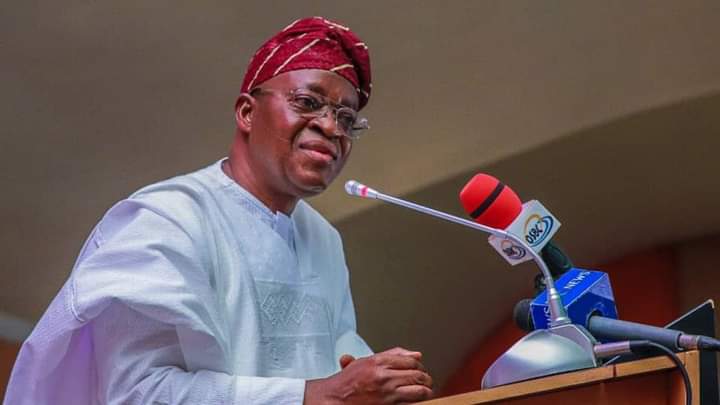
On Tuesday, Sharafadeen Alli, a former Secretary to the Oyo State Government, was elected as the All Progressives Congress (APC) senatorial candidate in Oyo South.
Waterfield Luxury Hotel, Akobo, Ibadan
Mr Alli was declared the winner of the Oyo South rerun primaries conducted at the Le Chatteau Events Centre in Ibadan.
According to report, Mr Alli received 185 votes to defeat his closest challenger Kolapo Kola-Daisi, who received 145 votes.
Kola Balogun, the current senator for Oyo South, received 84 votes, while Abimbola Adekanmbi, a former Commissioner for Finance under late Governor Abiola Ajimobi, received 72 votes.
Mr Alli, the present Maye-Balogun of Ibadanland, is a former Chief of Staff to former Governor Rashidi Ladoja.
The Governor of Osun State, Isiak Gboyega Oyetola has condemned the shooting of a journalist and a student by trigger-happy Police officers in Osogbo.
This waw contained in a statement made available to newsmen by the Governor as read in part:
“I condemn in strongest terms, the shooting of The Nation Newspaper correspondent, Toba Adedeji, and another citizen by some trigger-happy police officers at Olaiya, Osogbo, the State capital on Tuesday.
Waterfield Luxury Hotel, Akobo, Ibadan
“Shooting at journalists and unarmed citizens is completely unacceptable, irresponsible and condemnable. The police officers have no justification for this unfortunate and unlawful act. They could have employed other means rather than resorting to deadly force to disperse the group.
“The frequency of these unfortunate and avoidable provocative incidents is a source of concern to us, as a government. I have, therefore, directed the State Commissioner of Police to investigate the shooting incident and ensure that his officers who were involved in it are identified and punished in accordance with extant regulations and law.
“We must ensure that this kind of sad and barbaric incident does not occur again in our State.
“I wish the Nation Newspaper correspondent, Adedeji, and the other citizen whom I learnt are presently receiving treatment at the hospital, speedy recovery. I am also calling on residents of Osun to remain calm and not take the law into their own hands. I assure that this matter will be pursued to a logical conclusion and the erring officers dealt with accordingly”.
A discussion of the nationalism question in Nigeria has always revolve around the triumvirate of Obafemi Awolowo, Nnamdi Azikiwe and Ahmadu Bello in no particular order, but having an in-depth study into the life and times of these men, their aspirations, their politicking and conduct, were they really nationalists in the real sense of the word or mere accidental nationalists who wounded up to one another at independence, but fought dirty before and after for the prominence of their own aspirations and the lording of their own ethnic stock over the others?
The oldest of the triumvirate is Nnamdi Azikiwe who started off as a hothead journalist with African Morning Posts in Ghana before later founding his own West African Pilot in 1937. Nnamdi Azikiwe’s first entry into national politics was his involvement with the Nigeria Youth Movement, the country’s first nationalist organization which he left in acrimonious circumstance in 1941 when his anointed candidate Samuel Akinsanya was not elected for a vacant seat in the Legislative Council, the NYM executive council selected Ernest Ikoli who ironically was supported by Obafemi Awolowo ( this was the first political meeting between Azikiwe and Awolowo, which was the beginning of an intense rivalry within the political space of Nigeria between the duo which would last nearly half century). Nnamdi Azikiwe withdrew from the NYM, condemning the party of tribalism against the Ijebu-Yorubas and Igbos.
Waterfield Luxury Hotel, Akobo, Ibadan
Obafemi Awolowo on the other and rose to national consciousness in 1941, having joined the Nigeria Youth Movement earlier and supported the election of Ernest Ikoli into the Legislative Council in Lagos before proceeding to London to study Law and was eventually called into the English bar in 1944.
As a great grandson of Mohamed Bello, the son of the great Islamic scholar and jihadist of the 19th century, Uthman Dan Fodio, and having a sultan grandfather, Ahmadu Bello was different from Awolowo and Azikiwe as he was a blue blooded royalty. At the age of 28, Bello contested to become the Sultan of Sokoto but lost to Siddiq Abubakar III who reigned for 50 years until 1988, thus becoming the Sarduana (Crown prince) of sokoto and steadily rose through the traditional ranking. Ahmadu Bello rose to national consciousness with the formation of the Northern People’s Congress in 1949 from the Northern socio-cultural group Jammaya Islamiyya Arewa and he subsequently became its leader with his work in the 1950 All Ibadan constitutional conference as head of the Northern delegates.
Obafemi Awolowo, while studying in London has founded ‘Egbe omo oduduwa’, a student body of people of Yoruba descent, a group which was launched in Owo, the present Ondo state as the Action Group party to serve as the counter balance to the earlier formed National Council of Nigeria and Cameroun (NCNC, which was later changed to National Council of Nigerian Citizens) which was formed earlier by Nnamdi Azikiwe and Herbert Macaulay which the former was now leading and was gaining much traction in the western Nigeria ahead of the 1951 regional election. It is worthy of note that the1951 election was the first toe-to-toe political battle waged by Awolowo and Azikiwe, with the former castigating the latter as a nationalist who would prefer to be premier in Ibadan than in Enugu. With the inability of Azikiwe to be elected into the House of Representatives via the western region in 1951causing much disaffection between Awolowo and Azikiwe, the latter returned to the eastern region to become the premier in 1954, thus, the stage was set for an ethnic dominated politics in the first republic and beyond. The approach of the three men to the administration of the emerging heterogeneous structure called Nigeria is noteworthy, Obafemi Awolowo in his book ‘Path to Nigerian Freedom’ (1947) had advocated for the adoption of Federalism, with component units formed along ethnic lines. Azikiwe on the other hand, through his belief in the corporate existence of the country advocated Unitarianism while Ahmadu Bello advocated Confederalism. How the latter leaders could have advocated Unitarianism and confederalism respectively for a heterogeneous Nigeria is rather a bewilderment to say the least.
Close to Nigeria’s first republic, a huge seed of discord was sown among the three men when Tony Enahoro moved a motion for independence in 1956, fearing domination, Ahmadu Bello rejected the motion, replacing 1956 with the now unpopular phrase ‘as soon as practiceable’. The 1959 parliamentary election which was to usher Nigeria into the first republic was ethnically dominated, with the NPC and affiliates winning 134 of the 312, the NCNC and affiliates winning 89 and the AG and affiliates winning 72 seats, thus, the stage was a set for a coalition government between any of the three parties. Despite sharing the same progressive ideology and with a promise to step down from the position of Prime minister to minister of finance by Awolowo in his favour, Azikiwe led the NCNC to form an alliance with the conservative NPC in other to spite Awolowo for his 1951 daringness, in effect, Azikiwe ignored the offer of premiership to become a titular head of state under the NPC arrangement. It is now only left to imagination how an alliance of NCNC and AG with Azikiwe as prime minister and Awolowo as Finance minister would have set Nigeria on the path of prosperity in the First republic.
How much of a nationalist the duo of Bello and Azikiwe is left to posterity with the summary trial of Awolowo on trumped up treason charges as a result of the western region crisis of 1965/66 and the carving out of the mid-western region out of the western region in 1966 in a permanent attempt at limiting the influence of Awolowo and setting Nigeria up for its current state of lopsided federalism of which the very stock of Azikiwe are a victim.
The coup d’etat of January 1966 which claimed the life of Ahmadu Bello at the age of 56, according to repeated prophesies of Northern imams and diviners, cut his life short at his prime and denied him of his lifelong ambition of one day occupying the Sultanate in Sokoto but was still very enough to carve a place for him in the annals of Nigeria history as a champion of the north and an exporter of the domination at all cost mentality of his lineage, which has now gained much traction among northern elite and aristocrats.
The demise of the first republic did not however put paid to the growing profile and rivalry between Awolowo and Azikiwe which was soon put to test in the second republic with the formation of ‘national political parties’ which were at best a caricature of the first republic NCNC and AG. The Nigeria Peoples Party was formed and registered by the associates of the Owelle of Onitsha, the Unity Party of Nigeria by associates of the Odole Odua and the National Party of Nigeria by the remnant of the defunct NPC led by the docile Shehu Shagari, the other two political parties; GNPP led by Ibrahim Waziri was a result of in fighting in the NPP and PRP was re-incarnation of the first republic NEPU under the charismatic Mallam Aminu Kano.
Awolowo’s undoing in the second republic was a result of his inability to reach out to the other side of the south, especially to the eastern region where his controversial role in the Nigerian civil war was now his albatross, cheered on by a new messiah in Chukwuemeka Ojukwu, and still with the respected Owelle to contend with, Awolowo would register no meaningful electoral presence in eastern Nigeria. Also contributing to Awolowo’s woes is the fact that his first republic lieutenant; Tony Enahoro and J.S Tarka would hitherto held strategically important minority base of Edo and Benue for him were now in the folds of the NPN.
The enigmatic Owelle of Onitsha would make no meaningful impact outside of the Igbo heartland, especially in the north, no thanks to his role in the 1962/63 census crisis, and his reputation as an unstable ally. Aided by Ojukwu, some of his own even resented him because of his role in the civil war where he chameleon seamlessly between a Biafran ambassador when it pays and a pro-Nigerian when the weather looked different.
The 1983 election which was the last that was participated in by the duo of Azikiwe and Awolowo cemented their place in our national political history, just like in 1959, having lost in the election proper, Azikiwe danced gleefully to the invitation of Shehu Shagari’s government of national unity in 1979, on realising that the cream de la cream of his NPP membership handpicked by Shagari were being harvested into the ruling NPN, he pulled out of the political arrangement. With the abysmal performance of Shagari in office, it was clear that Nigerians wanted a change, after much dilly-dally and dragging feet, and at the very last minute the Owelle decided to throw his hat into the ring, running famously as the ‘beauty pride’ who had no real chance at the polls, much to the chagrin of Awolowo.
In fairness to the trio of Awolowo, Bello and Azikiwe, the politics of the pre and first republic with its regional and ethnic nature did not allow the men the ample ground to sow and harvest seed of nationalism, as primordial and ethnic sentiment must be spinned among the common men to gain their cult following, but all leaders have shown through their actions; Azikiwe through his preference for Unitarianism for an heterogeneous entity like Nigeria based on his belief of indivisible common destiny of the Nigerian people, but which was actually a veiled attempt at Igbo domination, which people in some quarters felt was acted on by the January, 1966 coup plotters, his subsequent prioritization of revenge over national interest in 1959 by the choosing the much conservative NPC over a much workable alliance with AG and lastly his macabre dance in the 1983 election where he should have retired as a statesman.
Ahmadu Bello’s propensity towards sectional interest over national interest was first shown in his opting for confederalism for an heterogeneous structure like Nigeria, an obvious indication of unbelief in the Nigerian state, his issuance of the 8 points agenda which demanded for a confederation after the motion for government fiasco in Lagos in 1953, his refusal to hire qualified Nigerians into northern civil service and the hiring of British expatriate in their stead, fearing domination are sure indices of anti-nationalism. Awolowo of the trio appeared to have a genuine belief in the Nigerian state when he, as early as 1947 suggested the adoption of federalism as a system of government for the Nigerian state, but Awolowo cannot be spared of his hatred, especially towards the northern elite, who he derisively described as feudal lords even on the campaign train, his prioritization of the Yoruba stock over the rest of his countrymen runs contrary to the spirit and meaning of true nationalist.
It is therefore evident from the life, politics and choices of these men that the appellation ‘Nigerian nationalist’ attached to them is nothing but vain glorification as some other men who were detribalized in their dealings, fought for the right of Nigerians notwithstanding their linguistic affinity such as Herbert Macaulay are more deserving of being ascribed Nationalist.
Ace Musician, Adeleke David popularly known as Davido, has lamented economic implications of rising dollar against naira. He claimed that something needs to be done urgently to reverse the upward movement of the flunctuation in the forex market.
In a tweet on Tuesday, he said, “Dollar heading to 1k. Drastic action is needed.”
Banks had on Monday lamented scarcity of forex and warned their customers of some delays in accessing it.
Many Nigerians had also taken to Twitter to lament the hardship brought to them by the instability in forex market.
During a shootout with demonstrators in Osogbo, personnel of the Nigeria Police Force shot at Toba Adedeji, an Osun State correspondent for The Nation Newspaper, and one unidentified female student.
Toba received a leg shot, while the other lady received a thigh shot.
Toba was transported to the UNIOSUN Teaching Hospital’s emergency unit.
At the Olaiya Flyover, police were negotiating with the outraged relatives of a police brutality victim.
On Monday, Babatunde Lukmon was driving to work from Ibadan when a trailer coming from the Saki end of the road lost control and slammed into his car, killing him instantly.
Babatunde Lukmon Kunle, a lecturer at the Oke-Ogun Polytechnic, Saki (TOPS), died on Monday as a result of injuries sustained in a head-on accident with a trailer on the Iseyin-Saki road.
Waterfield Luxury Hotel, Akobo, Ibadan.
On Monday, Lukmon was driving to work from Ibadan when a trailer coming from the Saki end of the road lost control and slammed into his car, killing him instantly.
Before his death, Babatunde was a senior lecturer at the Polytechnic’s Architectural department and was married with children.
The late educator, according to his high school classmates, was humble and approachable to his mates and friends while alive and will be sorely missed. The late Lukmon attended Iseyin District Grammar School and left the school in 1992.
Nollywood stars have been thrown into mourning following the demise of a Yoruba movie actor, Gbadebo Osmond.
Yoruba actress, Fausat Abeni, popularly known as Madam Saje, was among the first mourners late Monday.
The veteran actress shared an image of a burning candle on her Instagram page with the caption, “Goodnight Osmond,” accompanied with crying emojis.
Other Nollywood stars such as Yomi Fabiyi, Adeniyi Johnson, and others took to their Instagram pages to mourn the late actor.
Fabiyi wrote, “So so sad and a deep painful loss, Osmond Gbadebo. You are a fighter and safe to say you have gone to rest. Ever jovial, ever supportive and ever friendly. Rest in peace and power.”
Johnson wrote on his Instagram page, “This hits differently that I can’t even post your picture. Every soul around us knows I love you. How I wish…”
Ibironke Ojo-Anthony, popularly known as Ronke Oshodi Oke wrote, “It’s very hard for me to say goodnight, Gbadebo Osunmo, but God knows the best. RIP my darling friend.”
Shehu Sani, a former lawmaker from Kaduna Central Senatorial District, said on Monday that based on recent events in Nigeria’s political space, Vice-President Prof Yemi Osinbajo (SAN) “may step down” for Bola Tinubu, the ruling party’s National Leader, when the ruling party’s convention takes place next month.
Waterfield Luxury Hotel, Akobo, Ibadan
According to ODUDODUDU NEWS, the APC’s extraordinary convention for its presidential primary will take place from Monday, June 6 to Wednesday, June 8, 2022.
More than 20 party faithful, including serving members of President Muhammadu Buhari’s cabinet, governors, MPs, and business leaders, are among those aspiring to be the APC’s flagbearer, as the screening process began today.
The screening will take place at the Hilton Hotel Transcorps in Abuja, the nation’s capital.
“Aminu Tambuwal Stepped down for Atiku Abubakar.Pat Utomi stepped down for Peter Obi. Prof. (referring to Osinbajo) may step down for Jag (Tinubu),” Sani wrote on his verified Twitter handle.
The All Progressives Congress Presidential Screening Committee, which began sitting on Monday, questioned the party’s presidential aspirants on 10 key issues including their dual citizenship status.
Some of the aspirants, who were screened by the Committee headed by a former National Chairman of the party, the Chief John Odigie-Oyegun, told newsmen that the panel asked them if they would be ready to step down for the consensus candidate of the party.
The ruling party, which initially scheduled the screening of the presidential aspirants for May 16, shifted it to May 23, but failed to hold exercise on that day.
The APC in the guidelines on page 17 of the N100m nomination form obtained by the aspirants, barred the contestants from engaging in thuggery and taking it to court, among other seven conditions.
Although there have been reports that the party may adopt consensus, the National Chairman, Senator Abdullahi, who emerged through the method in March, in an interview with Voice of America Hausa Service on May 26, said it would not be feasible for electing the party’s presidential candidate.
Despite the Chairman’s statement, the issues of consensus and foreign citizenship came up when presidential aspirants including the party’s National leader, Bola Tinubu; Governor Dave Umahi of Ebonyi State, his Jigawa State counterpart, Badaru Abubakar; the immediate past Minister of State for Education, Emeka Nwajiuba; Ondo-North lawmaker, Senator Ajayi Boroffice; Pastor Tunde Bakare and Mrs Uju Kennedy-Ohanenye, were screened in Abuja on Monday.
The questions the aspirants were asked included, “Do you have dual citizenship? Are you the subject of investigation by the Economic and Financial Crimes Commission or the Independent Corrupt Practices and Other Related Offences Commission? Have you been arraigned by the Code of Conduct Bureau? And have you ever been convicted for a crime?”
Other questions asked include, “Have you ever been declared bankrupt? Will you be willing to step down for a consensus candidate? What is your manifesto? Will you abide by the party’s objectives and manifesto? What is your APC membership status?”
The aspirants were also asked to present original copies of their credentials including school certificates.
An aspirant, who wished to remain anonymous, said, “They asked us pretty much the same questions. They asked about our record with anti-graft agencies, citizenship status, finances and our manifestoes. Of course, there were a few follow up questions depending on the responses given.
“They asked if I had any EFCC (Economic and Financial Crimes Commission) or ICPC (Independent Corrupt Pactactics and other related offences Commission) case. They asked about my manifesto and also asked me if I would be willing to step down in the event of a consensus. I told them I am a party man and will abide by the wishes of the APC.”
The issue of dual citizenship has been a controversial issue in Nigerian politics with an Ondo State Election Petitions Tribunal ruling in 2019 that people who had sworn allegiance to a foreign country and acquired foreign citizenship ought not to hold public office. This judgment was, however, upturned by the Court of Appeal.
It was learnt that in some countries like the United States, foreigners who obtain citizenship through naturalisation are usually made to swear an allegiance to that country.
It reads in part, “I hereby declare, on oath, that I absolutely and entirely renounce and abjure all allegiance and fidelity to any foreign prince, potentate, state, or sovereignty, of whom or which I have heretofore been a subject or citizen; that I will support and defend the Constitution and laws of the United States of America against all enemies, foreign and domestic; that I will bear true faith and allegiance to the same; that I will bear arms on behalf of the United States when required by the law; that I will perform non-combatant service in the Armed Forces of the United States when required by the law; that I will perform work of national importance under civilian direction when required by the law; and that I take this obligation freely, without any mental reservation or purpose of evasion; so help me God.”
Such allegiance to a foreign power is usually seen as an albatross on the necks of those seeking sensitive public offices in Nigeria. Wealthy Nigerians and their families are known to acquire foreign citizenships for easy travel and other benefits.
Last week human rights activist, Kayode Ajulo, who is a campaigner for Vice-President Yemi Osinbajo, wrote a letter to the President, Major General Muhammadu Buhari (retd.), and the National Chairman of the APC, Senator Abdullahi Adamu, on the danger of picking a candidate with dual citizenship or past criminal record.
Ajulo said there was a plot by the opposition to ensure that the APC is disqualified on the basis of this just as was done in the Bayelsa governorship race in February 2020.
Badaru has not stepped down -Aide
Reacting to the screening exercise, Governor Badaru in a statement by his Media Aide, Auwal Sankara, said that the exercise went well and it was evidence that he had not stepped down for anyone.
According to the governor’s media aide, Badaru, issues determined by the panel were verification of his membership and financial statuses as well as his academic credentials, and other requirements for a presidential candidate as stipulated in the Nigerian Constitution.
He said his principal was among the “28 APC Presidential Aspirants and we are hopeful he will clinch the party ticket due to the massive support he is garnering from party faithful, supporters and relevant stakeholders in the country.”
Fiery cleric, Pastor Tunde Bakare, while addressing journalists, said he was satisfied with the screening process.
Bakare added that he was confident of defeating former Vice-President Atiku Abubakar, the Peoples Democratic Party’s presidential candidate, if he was given the ticket.
The Serving Overseer of the Citadel Global Community Church, Pastor Tunde Bakare, described the presidential candidate of the PDP, former vice president Atiku Abubakar, as a worthy candidate.
Asked about the exercise, he said, “The screening exercise went very well. Appropriate questions were asked about how we are going to fix the challenges facing our nation and appropriate answers were given to them.
“By God’s grace, we are pleased that we had something to offer this nation. In this critical moment in our history, nobody can say I have all the solutions. But we did say to them that we will assemble the best, brightest and fittest from within the country, north and south, and from outside of the country, those in the diaspora.
“The time has come for us to raise the foundation of many generations, to restore our path and ensure that our nation becomes great again.”
Meanwhile, it was learnt that like the opposition PDP, the APC snubbed the request of the Drug Law Enforcement Agency to administer drug tests on aspirants.
Aspirants told the newsmen that there was no mention of a drug test by the party.
It was learnt that the Oyegun-led committee would submit its report to the national chairman who would in turn forward it to President Buhari for action.
Kano APC member petitions panel, demands Tinubu’s disqualification
Meanwhile, a member of the APC in Kano State, Sagir Mai Iyali, has written a petition against Tinubu seeking his disqualification by the Oyegun-led committee.
Iyali in a letter dated May 17, 2022, demanded the disqualification over the former governor’s “questionable educational qualifications”.
He also claimed that Tinubu allegedly submitted false documents to the Independent National Electoral Commission in 1998.
Iyali said although Tinubu is above the required age to contest the office of president, his age is not known, adding that obscurity surrounding the presidential hopeful could jeopardise the party’s chances at the polls.
It reads in part, “We understand that Bola Tinubu who has since procured his expression of interest and nomination forms and has submitted the same to the party has certain issues that clearly amount to a similar disqualification scenario.
“From the information contained in prior submissions to INEC particularly in 1999, Mr. Tinubu presented a false claim, on oath, of his attendance at University of Chicago from 1972-1976.
“It is clear now that these claims are false. Not only was this filed in the INEC form with a declaration on oath on December 20 1999, it was also contained in an affidavit of loss sworn to before the High Court of Lagos, Ikeja Registry, December 29, 1998.”
The petition Tinubu has to show proof he attended University of Chicago or he must stand disqualified as the opposition is in possession of his questionable credentials.
“Over the years, the identity of Asiwaju Bola Tinubu has been shrouded in secrecy. In fact, no one can claim to know the identity of the man. Repeated efforts and demands by the general populace and the media to unravel the identity of Asiwaju Tinubu have all proved abortive and unsuccessful,” he wrote.
In his response, Tinubu’s Media Aide, Tunde Ramon, at 9.30pm on Monday said a statement would be issued soon. But as of 10.50pm, he had yet to send the statement.
Ogun State governor, Dapo Abiodun, has appealed to those who lost in the recent All Progressives Congress (APC) primary elections held across the state to remain calm and take the outcome of the elections in good spirit.
This is just as he promised that they would be duly compensated for their show of sportsmanship, acknowledging their resilience.
Abiodun made the promise on Sunday at the Presidential Lodge, Abeokuta, while addressing members of the state executive committee of the party, secretariat staff and some party faithful, to commemorate his 62 birthday and third year in office.
The governor, who recalled his experiences while seeking political office, said he had contested several elections and lost, explaininh that as far as the recent primary elections were concerned, there are no winners or losers.
“We had about 180 people who aspired to go to the House of Assembly, 80 aspired to go to the House of Representatives and I am not even sure of the number of those who wanted to go to the Senate. Of course, out of those who contested, we had those who were serious and those who were obviously comedians.
“I am not an emperor by any chance and this is not my family inheritance. I am holding this position in trust for all the people of this state and I have vowed to be fair, just and equitable and this is my solemn agreement I made between the Almighty God and myself.
“To that extent, I have tried in every way to find a consensus around those to be chosen. I ensured that I consulted the party leadership because this is a democracy. In some instances, the person I actually wanted has not emerged and in some instances, they have, but all of us would not emerge. Regardless of that, I want us to see ourselves as winners and I can assure you that you will be well taken care of”, the governor said.
He, however, appreciated the people for their support and prayers, saying “I have tried with all sense of humility knowing fully well that it is by the grace of God and the collective will of all of you that I am standing here and I will not take it for granted”.
Abiodun, while also acknowledging the contributions of the state executive members and his staff, he urged them not to relent, but work harder to ensure that the state is well positioned just as he observed that the current administration conducted the most transparent and fairest governorship primary election in the history of the state
The governor said the day of the governorship primary election was triple celebrations as the current administration clocked three years in office and coincided with his sixty two years birthday.
He stressed that those who have supported the party in getting to its present position needs to be appreciated, while those that have lost their lives should also all be remembered.
Abiodun assured that his government would continue to prioritize the welfare of the people by ensuring that programmes and policies are people-oriented.