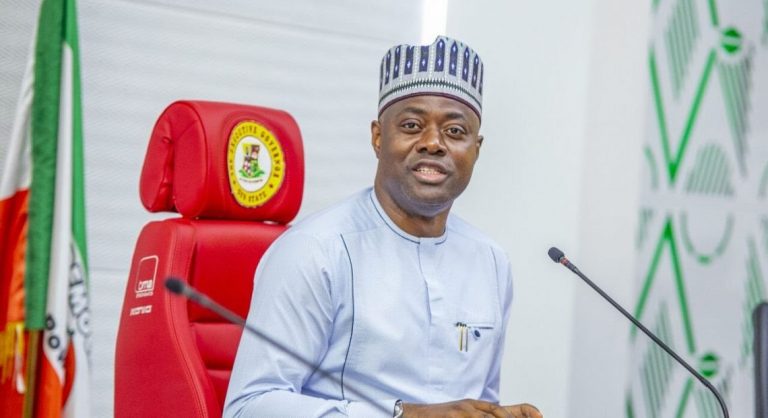
Debt Burden May Collapse Oyo State Before May 2027, APC Raises Alarm As Makinde Takes Fresh N300Billion Loan

The All Progressives Congress APC in Oyo state has raised the alarm over fresh N300 billion allegedly obtained by Governor Seyi Makinde stating that the development signalled a problematic future for the economy of the state as well as the welfare of the people.

Sources informed that some members of the state House of Assembly were recalled from their annual recess by the Speaker, Hon. Debo Ogundoyin, to urgently reconvene on August 16 and 26, 2023 for the purpose of giving an approval to the request of Gov. Makinde as this was surreptitiously done without the knowledge of the four members who got elected to the Legislative Chamber on the platform of the APC.

In a statement issued on Thursday and made available to journalists in Ibadan by its Publicity Secretary, Olawale Sadare, APC threatened to mobilize citizens from all the nooks and crannies of the state to stage a violence-free protest against the administration of Gov. Makinde to protest the unabated profligacy, lack of transparency and gross abuse of the Due Process law of the land which his government is well known for.

“Now that Gov. Makinde has convinced the whole world that he has no good plan for the good people of the Pacesetter state with regards to their future, it is very important for all well-meaning individuals from within and outside the state to rise up to the occasion and take necessary steps to stop the heist which he has foisted on the people since 2019.

“The fresh N300Billion Loan which the Hon. Debo Ogundoyin-led Legislative House rubberstamped for collection by the governor on August 19, 2025 was the third in the series in 2025 alone because the same governor got a N200billion loan in March and another N110billion French Treasury Concessional loan in July making it a total of N610billion in a year that is just eight months-old. We should not forget that the same governor has got over N180billion in allocations from Abuja and internally generated revenue in 2025 but the masses cannot feel the direct impact of all the huge resources in their life.

“A few days ago, Gov. Hope Uzodimma of Imo State hinged his decision to increase the minimum wage for workers in his state to N104,000 on the availability of more funds from Abuja but in Oyo state, it is more money and more borrowing while the ubiquitous hijack and sale of private and public properties still continue unabated. Another question in the mouth of the citizens bothers on the inability of the governor to showcase what he has done with the over N900billion which he has obtained since he became governor in 2019.

“The saddest part is the willing tool of sleaze in the hand of Gov. Makinde which the Speaker of the State House of Assembly and a few of his colleagues have turned themselves into. We can advise that the good people of the state should remain calm and endure the remaining 20 months of Makinde administration but we are not sure of what the direct impact of unnecessary debt burden would be on the life of an average citizen and resident before and after May, 2027.” Sadare lamented.

Oyo Assembly Refutes Secret ₦300bn Loan Approval, Labels Claim ‘Misleading’

The Oyo State House of Assembly has issued a rebuttal to the claims made by Hon. Ibrahim Shittu, member representing Saki West State Constituency, over the recent emergency plenary session which he falsely alleged was used to secretly approve a N300 billion loan request from the Executive without proper notification to members.

In a statement jointly signed by the Majority Leader, Hon. Sanjo Adedoyin and the Chairman, House Committee on Information, Media, Public Affairs and ICT, Hon. Waheed Akintayo (Ilumoka), the Assembly described Hon. Shittu’s claims as not only misleading but a reflection of his complete disconnect from legislative responsibilities.

Recall, Hon. Ibrahim Shittu representing Saki West had earlier accused his colleagues for secretly approving N300bn Loan to Makinde amid surging Federal Allocation increase.

The statement clarified that the emergency plenary held on Tuesday, August 19, 2025, was duly and officially notified on the Assembly’s general platform.

According to the statement made available today to Oduduwa News by Oyo Assembly as read in part. The House was quoted as saying thus:

“A screenshot of the message from the Majority Leader clearly indicates that all Honourable members were informed of the session, a notification acknowledged by some members.

“It is not only unfortunate but shameful that a serving member of the Assembly would resort to falsehood for cheap political relevance. Emergency plenaries are not illegal; they are constitutional and practiced in all serious legislatures across Nigeria, including the National Assembly,”.

In refuting Hon. Shittu’s claims, the statement disclosed that the so-called N300 billion loan includes N149 billion meant to refinance an existing loan facility with United Bank for Africa (UBA), while only N151 billion constitutes a new request to support infrastructure and contractors’ financing, a distinction Hon. Shittu failed to acknowledge, either ignorantly or deliberately.

The House also expressed serious concern over Hon. Shittu’s abysmal performance and participation rate. The House further stated that Hon. Shittu’s attendance at plenary sessions stands at a dismal 20%, making him the least active member of the 10th Assembly.

“Hon. Shittu is always absent at all critical legislative sittings such as the budget presentation and the State of the State Address by the Governor. Hon. Shittu was the only member who failed to participate in the recently concluded extensive oversight visits to executive and local government projects across the state. His absence extended to all previous oversight duties and committee assignments, where his contributions are either non-existent or irrelevant.”

“It is clear that Hon. Shittu has not only failed his constituents but also betrayed the legislative mandate he was entrusted with. He has no bill, no motion, no contribution on the floor, and now seeks to cover his ineffectiveness with lies,” the statement added.

The House reiterated its commitment to accountability, transparency, and legislative excellence, while urging the public to disregard the politically motivated antics of non-performing lawmakers.

“Rather than peddle unfounded allegations, Hon. Shittu should redirect his energy towards becoming a functional Legislator. His pattern of absenteeism and non-participation is an embarrassment to the institution and to the people of Saki West,” the statement concluded.

2027: PDP Leaders Woo Jonathan As Hashim-Olawepo Loyalists Kick Against Zoning To South

Leaders of the Peoples Democratic Party (PDP) are holding high-level consultations to persuade former President Goodluck Jonathan to contest the 2027 presidential election on the party’s platform.

Sources close to Jonathan confirmed that some party chieftains recently met with him to mount pressure, but the former president reportedly told them he was still consulting and would communicate his decision in due course.

The development came just as PDP presidential aspirant, Dr. Gbenga Olawepo-Hashim, rejected the party’s decision to zone its 2027 presidential ticket to the South, insisting that the final say rests with the party’s national convention and not the National Executive Committee (NEC).

Olawepo-Hashim described the zoning arrangement as “undemocratic and unconstitutional,” arguing that it would deprive the PDP of its best options in a crucial election year.

At its 102nd NEC meeting held in Abuja on Monday, the PDP had formally zoned its 2027 presidential ticket to the South, a move that has triggered mixed reactions, particularly from some Northern groups that openly opposed the decision.

In a boost to his campaign, members of the PDP in the Federal Capital Territory (FCT) have endorsed Olawepo-Hashim’s candidacy, declaring their rejection of the zoning formula.

At a meeting attended by stakeholders including party chairmen, flag bearers, councillorship candidates, and area council secretaries, the members pledged loyalty to his ambition and formally adopted him as the political leader of the FCT.

Meanwhile, the PDP leadership has dismissed speculations that the zoning decision was designed to promote the influence of the Minister of the Federal Capital Territory, Mr. Nyesom Wike. Party officials stressed that the move was taken in the interest of stability and to strengthen internal cohesion ahead of the 2027 polls.

Bauchi State Governor, Bala Mohammed, also defended the decision, describing it as a “sacrifice for unity.” According to him, zoning the presidential ticket to the South was necessary to foster inclusiveness and preserve the party’s national outlook.

As consultations continue, the question of Jonathan’s possible return and the dispute over zoning are expected to shape the PDP’s internal dynamics in the build-up to the 2027 general elections.

One Dead, Others Injured As Market Traders, Hoodlums Clash In Lagos Island

Chaos erupted in the Mandilas area of Lagos Island as traders and area boys engaged in a fierce fight that left one person dead and several others injured.

The clash, which broke out suddenly, forced many residents and passersby to flee for safety as the battle turned violent. Eyewitnesses reported that shops were hurriedly shut while the streets descended into panic.

Though the exact cause of the fight remains unclear, the violence has heightened tension in the busy commercial hub. Security operatives are yet to release an official statement on the incident.

Approval Of ₦300bn Loan To Makinde Amid Surging FAAC Is Sheer Recklessness — Oyo Lawmaker Faults Assembly

Hon. Shittu Ibraheem, representing Saki West State Constituency in the Oyo State House of Assembly, has disassociated himself from the approval of a ₦300 billion loan by the Assembly.

In a statement issued on Wednesday, Ibraheem clarified that he was not part of the lawmakers who sanctioned the loan during an emergency plenary session convened on August 26, 2025.

According to him, the House has been on a six-week recess since July 31, scheduled to end on September 16. However, the emergency sitting was allegedly arranged without proper communication to all members.

“I want it on record that I was not among the lawmakers who approved the ₦300 billion loan. Why was the loan an emergency, and why was the sitting not communicated to every honorable member?” he queried.

The lawmaker also questioned the rationale behind seeking such a loan at a time when Oyo State reportedly enjoys about a 500% increase in its FAAC allocation.

He urged residents to hold their leaders accountable, stressing that borrowing under the present financial circumstances raises serious concerns.

UI Lecturers, NLC Protest in Ibadan, Warn FG of Imminent Nationwide Strike

Academic Staff Union of Universities (ASUU) members at the University of Ibadan on Tuesday staged a peaceful protest within the campus, demanding that the Federal Government urgently sign and implement the renegotiated 2009 agreement.

The lecturers, joined by officials of the Nigeria Labour Congress (NLC), carried placards with inscriptions such as “Sign the Agreement, Save Education” and “Preserve Those Who Lay the Golden Eggs.”

Chairman of ASUU, University of Ibadan chapter, Dr. Adefemi Afolabi, said the union was tired of government’s endless promises and warned that failure to act by the August 28 deadline could lead to a nationwide strike.

Similarly, Oyo State NLC chairman, Mr. Kayode Martins, decried the neglect of university lecturers, stressing that “those who lay the golden eggs must be preserved.” He noted that the poor welfare of academics was fueling brain drain and crippling Nigeria’s education system.

The protest at UI mirrored similar demonstrations across public universities nationwide, as ASUU reiterated that unresolved salary arrears, stalled agreements, and lack of adequate funding for education would no longer be tolerated.

The union maintained that unless the Federal Government takes concrete steps at Thursday’s meeting, the country should brace up for another round of industrial action that may disrupt academic activities across campuses.

Makinde Embarks On One-Month Leave, Writes State Assembly To Transfer Power To Deputy

Oyo State Governor, Seyi Makinde, has proceeded on an official leave as approved by the State House of Assembly.

The governor, in a formal communication to the Assembly, notified lawmakers of his decision to take the statutory leave.

In his absence, Deputy Governor Barr. Bayo Lawal will assume the role of Acting Governor to ensure continuity of governance across the state.

Governor Makinde expressed confidence that ongoing projects and government activities will continue seamlessly while he is away.

Super Falcons Captain, Rasheedat Ajibade Joins PSG Féminines

Nigerian forward Rasheedat Busayo Ajibade has completed a move to French giants Paris Saint-Germain (PSG) Féminines, where she will team up with fellow Super Falcons star, Jennifer Echegini.

“Paris Saint-Germain is delighted to announce the arrival of Nigerian striker Rasheedat Busayo Ajibade, who has joined the club on a deal that runs until 30th June 2027,” PSG confirmed in a statement on Tuesday while unveiling their new signing.

Speaking after her presentation, the Nigerian captain, fondly called Mummy G.O., described the transfer as a landmark moment in her career, saying it was a “major step” for her.

Ajibade’s switch to PSG comes just weeks after she led the Super Falcons to their record-extending 10th Women’s Africa Cup of Nations (WAFCON) triumph. She was also named Player of the Tournament, marking her second time lifting the prestigious continental trophy with Nigeria.

NUC Visits Newly Established University of Agriculture And Technology, Okeho For Verification Exercise

The Federal University of Agriculture and Technology, Okeho, Oyo State operating from its temporary site in Okeho, hosted officials of the National Universities Commission (NUC) and officials of Ministry of Education who visited the institution for a verification exercise.

The exercise, which is a critical step in the accreditation and recognition process of new universities in Nigeria, focused on assessing the facilities, academic structures, staffing, and readiness of the institution to commence full academic operations.

During the visit, the NUC team inspected classrooms, laboratories, administrative offices, and other key facilities at the temporary site. The verification exercise is expected to pave the way for the university to secure necessary approvals to begin admitting students into various academic programmes.

It was gathered that academic activities have been slated to resume by December after the necessary arrangement has been put in place to ensure hitch free academic exercise.

Stakeholders in Okeho and across Oyo State have expressed optimism that the establishment of the University of Agriculture and Technology will boost access to tertiary education, foster agricultural innovation, and contribute to the socio-economic development of the region.

The Aladikun Crown Controversy: Legal, Historical, and Political Reflections on Yoruba Royalty || By Abdul Waheed Lawal

The Yoruba tradition, rich in history, culture, and mythology, often presents complex narratives over kingship and lineage that continue to resonate in contemporary discourse. A particularly compelling issue in recent times involves the figure of Aladikun, his purported crown, and its contentious relationship with the Alaafin of Oyo. This matter not only raises important cultural and historical questions but also poses significant challenges within the legal and political frameworks of traditional governance in Yorubaland.

Aladikun in Yoruba History and Tradition: A Question of Identity and Authority
The figure of Aladikun remains both revered and enigmatic in Yoruba lore.

Was Aladikun a monarch, a mythological ancestor, or a potent symbol of authority preceding or contemporary to the Alaafin?

Legal principles governing traditional rulership in Yoruba land emphasize clear lineages, succession rules, and the sacred legitimacy of royal insignia, such as crowns, as custodians of power and identity.

Understanding Aladikun’s historical and genealogical status is critical for appreciating the gravity of the crown dispute.

The Crown: Symbolism, Ownership, and Legitimacy
At the heart of the debate is a venerated crown—traditionally attributed to Aladikun’s family—that reportedly found its way into the possession of the Alaafin of Oyo. The statement, “Alaafin ko l’ade ade Aladikun la gbà fún aláàfin,” loosely translated as “The Alaafin did not have a crown except the crown of Aladikun given to him,” invites rigorous legal and symbolic examination. Crowns in Yoruba tradition are not mere ornamental objects; they embody spiritual and political sovereignty recognized by kingmakers, religious custodians, and the broader community.

The alleged transfer or acquisition of Aladikun’s crown by the Alaafin raises poignant questions about rightful ownership and authority. Was the crown lawfully and consensually passed on? Were the processes in line with customary law and protocols? Such inquiries merit thorough legal scrutiny, particularly in light of the traditional Yoruba framework that mandates structured, transparent procedures for enthronement and the bestowal of regalia.

Dynamics Between Yoruba Monarchs: Power, Protocol, and Precedent
This dispute implicitly challenges the hierarchical and cordial relationships historically maintained between the Alaafin of Oyo and other Yoruba rulers, notably the Ooni of Ife. It questions the historical arrangement of political power and cultural heritage, underscoring the delicate balance Yoruba traditional systems strive to maintain.

As custodians of both spiritual and political authority, Yoruba monarchs derive legitimacy not only from bloodlines but also from observance of “eewo” (cultural prohibitions) designed to regulate their powers and preserve societal harmony. The allegation that the Alaafin’s crown originated from Aladikun’s lineage, therefore, must be contextualized within these socio-political checks and balances, suggesting potential challenges to the Alaafin’s unquestioned sovereignty.

Contemporary Implications and the Aladikun Family’s Agitation
Represented prominently by Yoruba activist Sunday Igboho, the Aladikun family has publicly asserted claims that the crown traditionally associated with the Alaafin was originally theirs. Igboho’s pronouncement during his auspicious visit to the Ooni of Ife’s palace highlighted historical grievances, emphasizing the need for Yoruba unity while drawing attention to perceived historical injustices.

The family’s demands raise fundamental questions: Do they seek the physical restitution of the crown? Would such a claim be resolvable through Nigeria’s legal system, or would it require mediation via traditional councils? Could the agitation escalate into conflict, or might it serve as a catalyst for reconciliation and cultural re-examination? Legally, any claim to traditional symbols must navigate the tribunals of customary law, statutory law, and conflict resolution mechanisms established by the Yoruba socio-political order and Nigeria’s constitution.

Legal and Political Perspectives on Resolution
From a legal standpoint, the contestation over the Aladikun crown invites examination under Nigeria’s complex interplay of customary and statutory law. Nigerian jurisprudence recognizes the authority of traditional institutions while also emphasizing the rule of law, peace, and public order. Thus, any dispute necessitates a balanced approach that upholds cultural heritage yet prevents divisiveness.

Politically, the feud between the Alaafin and the Ooni—as symbolic apexes of Yoruba monarchy—signals profound implications for Yoruba unity and governance. It underscores the urgent need for dialogue, mutual respect, and perhaps formal arbitration to mitigate historical grievances while fostering collective progress.

Conclusion: Towards Historical Justice and Yoruba Unity
The Aladikun crown controversy is more than a dispute over a royal artifact; it is a profound reflection on identity, authority, and historical justice in Yoruba land. It challenges all stakeholders—traditional rulers, legal experts, and political activists alike—to engage with this issue not as an adversarial conflict but as a moment to deepen understanding, rectify historical oversights, and strengthen the unity that has long defined Yoruba civilization.

The path forward requires that we honor the sanctity of tradition while embracing modern legal principles and political prudence. In doing so, Yoruba society can uphold its rich heritage and pave the way for peaceful coexistence and sustainable development.

Abdul Waheed Olatunde Lawal is a legal practitioner and political Activist writes from Saki -Okeogun, Oyo State. wolawal@yahoo.com

You cannot copy content of this page