“Don’t Commit Political Suicide,” Makinde Warns Wike Camp Against Disrupting Planned PDP Convention

Oyo State Governor Seyi Makinde has issued a stern warning to factions within his own party, urging that no one should engage in “political suicide” over disagreements surrounding the upcoming PDP National Convention. His admonition came in the context of efforts by some leaders aligned with Nyesom Wike to challenge or halt the party’s convention plans. 

Makinde, who chairs the PDP National Convention Transportation Subcommittee, spoke on Monday shortly after unveiling the committee in Abuja. He said that attempts to stop what he described as a “moving train” — the party’s march toward convention — would amount to self-destructive behavior. “My advice is this: no matter how highly placed, no matter what has transpired in the past, we don’t want to see anyone dead. So please, don’t commit suicide,” he warned. 

His comments followed months of internal dissent within the Peoples Democratic Party, especially from some who contend that zones and leadership positions have been unfairly micro-zoned or allocated. Some Wike-aligned actors have openly threatened legal action to restrain the convention from going ahead. 

Despite defections by some prominent figures to the ruling APC or other coalitions, Makinde insisted the PDP remains focused and undeterred. He said the party would allow the people to make the final judgment at the polls. 

When asked whether his own presidential ambitions might influence his posture, the governor downplayed such speculation, stating his priority was to ensure a successful and credible convention first. 

PDP Postpones 103rd NEC Meeting Amid Internal Crisis

The Peoples Democratic Party (PDP) has postponed its 103rd National Executive Committee (NEC) meeting, earlier scheduled for Wednesday, October 15, 2025, citing recent developments within the party.

The postponement was announced in a statement posted on X (formerly Twitter) on Monday by the party’s National Publicity Secretary, Debo Ologunagba.

According to the statement, the decision followed an emergency meeting of the National Working Committee (NWC) held in Abuja, where members resolved to shift the NEC meeting to a new date that will be communicated later.

“Distinguished members of the National Executive Committee (NEC) may recall that the 103rd NEC meeting was scheduled for Wednesday, 15th October, 2025,” Ologunagba stated.

“However, in view of recent developments in the party, the NWC, in exercise of its powers pursuant to Section 29 (2)(b) of the PDP Constitution (as amended in 2017), has approved the postponement of the meeting to a new date that will be communicated to members in due course.”

The party urged all NEC members to take note of the change and await further communication from the national secretariat.

The development comes amid a wave of defections of key PDP members to the ruling All Progressives Congress (APC), which has heightened internal tension within the opposition party.

In response to the defections, the Chairman of the PDP Governors’ Forum and Bauchi State Governor, Bala Mohammed, has assured party faithful that the PDP remains united and resilient.

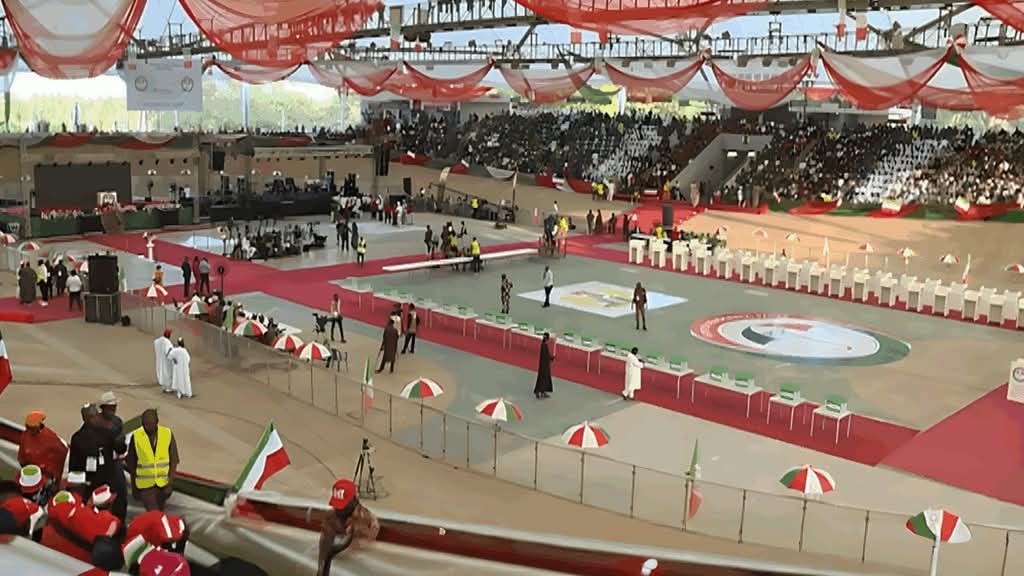
Mohammed stated that no political defections or external pressure would derail the party’s plans for its National Convention, scheduled to take place in Ibadan, Oyo State, between November 15 and 16, 2025.

Sanwo-Olu, Ooni, Uzodinma, Others Renew Call for Constitutional Roles for Traditional Rulers

Governors and monarchs across Nigeria have renewed calls for constitutional recognition of traditional rulers, emphasizing their importance in grassroots governance, peacebuilding, and cultural preservation. The appeal was made during the meeting of the National Council of Traditional Rulers of Nigeria (NCTRN) held in Lagos, attended by ten governors, royal fathers, and dignitaries nationwide. The event, themed “The Traditional Institution: The Imperative of Its Inclusion in Effective and Efficient Governance in Nigeria,” sought to secure a defined constitutional role for traditional rulers in the country’s governance framework.

Governor Hope Uzodimma of Imo State, representing President Bola Tinubu, stressed that monarchs are the strongest link between government and the people and deserve legal recognition for their roles in conflict resolution and community development. He noted that while traditional rulers had defined responsibilities under the 1963 Constitution, these roles were removed in later versions, creating a gap in governance. Uzodimma urged the National Assembly to correct this oversight through constitutional amendment and advised monarchs to remain politically neutral while supporting national unity.

Lagos State Governor Babajide Sanwo-Olu echoed these sentiments, describing traditional rulers as moral authorities and custodians of cultural values who play a vital role in maintaining peace and order. He called for their reintegration into governance structures in a practical, non-ceremonial manner, pledging Lagos State’s support for the initiative. Sanwo-Olu emphasized that clarifying the roles of monarchs would strengthen collaboration between government and traditional institutions, ultimately enhancing community stability and national development.

The meeting, co-chaired by the Sultan of Sokoto, Alhaji Sa’ad Abubakar III, and the Ooni of Ife, Oba Adeyeye Ogunwusi, also featured appeals for reform of existing laws that place traditional councils under local government control. Monarchs and governors alike argued that formal recognition would not disrupt democracy but rather complement it by legitimizing existing traditional functions. They urged the National Assembly to prioritize the inclusion of traditional institutions in Nigeria’s ongoing constitutional review process to promote stability, unity, and sustainable development.

FG Warns ASUU: “No Work, No Pay” as Lecturers Begin Warning Strike

The Federal Government has warned the Academic Staff Union of Universities (ASUU) that it will enforce the “no work, no pay” policy after lecturers began a two-week warning strike to protest unpaid arrears and poor implementation of past agreements.

The Ministry of Education said the rule is backed by labour law and will apply if the strike continues.

ASUU, however, insists that the policy is unfair and that government has not fully met its commitments under the 2009 agreement.

Stakeholders are urging both sides to resume dialogue to prevent disruption of the academic calendar.

Uncertainty Trails NECO’s Proposed 2026 CBT as Meeting with Operators Ends in Deadlock

Uncertainty now surrounds the implementation of the proposed 2026 Computer-Based Testing (CBT) format for the National Examinations Council (NECO) examinations following a virtual meeting between the Council and CBT centre owners that ended in a deadlock on Wednesday.

The meeting, held via Zoom on October 9, 2025, had over 450 CBT centre owners and managers in attendance.

What began as a seemingly smooth and interactive engagement soon degenerated into a heated exchange after the NECO consultant, identified as Mr. Temi of MG, announced that ₦1,000 per session had been earmarked as payment for each centre during the exams.

The announcement reportedly angered many participants, who described the amount as “unrealistic” and “unsustainable” given the high cost of running and maintaining CBT facilities.

Several centre managers questioned whether the ₦1,000 fee would cover diesel expenses and other operational costs incurred during both the preparation and conduct of the exams, which typically span several weeks.

In his response, the NECO chairperson, who also attended the session, compared the proposed rate with what other examination bodies currently offer. He, however, insisted that since NECO’s examinations usually last longer, the amount was “reasonable.”

The explanation did little to calm the participants, who continued to express strong reservations about the proposal.

One of the centre owners, who spoke on behalf of others, demanded to know whether NECO had developed a formal working document that would outline the operational guidelines and expectations for the exercise.

In response, the consultant affirmed that such a document would be made available only to centres that successfully complete an “Autobot Test” a prerequisite evaluation exercise scheduled to end on October 16, 2026.

However, multiple CBT operators who spoke to our correspondent after the meeting expressed disappointment and scepticism about the proposed arrangement.

According to one of them, many centres are reluctant to participate because of the low payment and the relatively low turnout of candidates for NECO’s November/December examinations.

“There is little incentive for us to invest time and resources in preparing for a process that may not even be profitable. NECO needs to review its proposal and engage stakeholders meaningfully if it wants to succeed,” one operator said.

The Tribune gathered that several CBT centre owners have begun reconsidering their participation in the exercise, citing poor consultation, cost implications, and the absence of a clearly defined operational framework.

As of press time, NECO had yet to issue an official statement on whether adjustments would be made to the proposed payment structure or timeline for implementation of the computer-based testing model.

Breaking: ASUU To Begin Nationwide Warning Strike Tomorrow

Compatriots of the Press, it is evident that nothing concrete has been done to halt the implementation of the resolution reached by ASUU-NEC to embark on a two-week warning strike following the expiration of the 14-day notice issued on 28th September 2025.

Accordingly, all ASUU branches are hereby directed to withdraw their services effective from midnight on Monday, 13th October 2025.

This warning strike, as resolved at the last NEC meeting, shall be total and comprehensive.

‘APC Prefers 2027 Politics to National Survival’ — Gbenga Hashim Slams Tinubu Over Insecurity

Former presidential candidate and Peoples Democratic Party (PDP) chieftain, Dr. Gbenga Hashim, has berated the Federal Government over what he described as its “shamefully political and dangerously unserious” response to Nigeria’s deepening insecurity crisis.

Hashim said the government’s reaction to growing terrorist and bandit attacks has been driven more by propaganda and partisan considerations than by a genuine commitment to protect citizens.

“This government treats the blood of innocent Nigerians like a campaign statistic,” Hashim lamented in a statement at the weekend. “Instead of confronting terrorists and bandits, they are busy issuing statements and blaming imaginary enemies. Governance is not propaganda. The APC is more interested in securing PDP governors ahead of 2027 than securing Nigeria. Rather than uniting the country, the APC is pitching the South against the North.”

The Global Energy entrepreneur said the recent move by the United States to consider placing Nigeria on a watchlist of countries of concern over religious and security issues was a direct consequence of the government’s “failure to protect its citizens and confront terrorism with sincerity.”

“While Nigeria does not have a state policy of genocide or persecution against Christians or any particular group, the levity with which the government has handled terrorist activities should worry every decent human being , not only Americans,” he said.

Hashim warned that if the current trend continues, terrorist networks could establish parallel governments in parts of northern Nigeria before 2027, with the North Central zone becoming their main battlefield.

He accused the political elite of being consumed by the race for 2027 elections instead of working to stabilize the country.

“Too many politicians are dancing around 2027, ignoring the fire already consuming the nation. If this continues, the context for elections may not even exist when the time comes,” he cautioned.

Turning to the economy, Hashim faulted the Tinubu administration’s fiscal direction, especially what he called “the endless imposition of taxes and levies on already suffering citizens,” warning that such policies were worsening poverty and insecurity.

“When people can’t eat or live in dignity, social violence becomes inevitable,” he said. “You can’t tax hunger out of poverty, you only create more chaos.”

Hashim urged the Federal Government to urgently reform the national security architecture, tackle the economic roots of violence, and unite Nigerians around a genuine plan for peace and development.

“We must save Nigeria now. Delay is dangerous. This is not about politics anymore, it is about the survival of our nation.” He concluded.

Road Project Face-Off: Umahi Fires Back At Makinde Over Cost Per Kilometer Criticism

The Minister of Works, Engineer David Umahi, has reacted to comments made by Oyo State Governor, Seyi Makinde over the ongoing controversy about the cost of road projects under the current administration.
 
Governor Makinde on Thursday berated Umahi for failing to reveal details in the costing of the project when he appeared on Arise TV.

Responding, Umahi expressed his disappointment while inspecting the Keffi section of the Abuja- Mararaba-Keffi road, along side the Nasarawa State Governor, Abdullahi Sule, on Saturday, October 11.

 “I have a lot of respect for governors and the Governors Forum but if a governor that is far my junior in engineering and governance insults me I will talk back.

One thing I’m very good at is mathematics. I’m an A student in mathematics. This controversy about cost per kilometer, I have told you that this project is about 43 kilometres but we have increased it to utilize the money given for the project by the last administration which was N73 billion, we have increased it to about 45 kilometers.

If we are doing surface tracing on the shoulder, the cost will be different, it we are using asphalt on the shoulder, the cost will be different, if we are using concrete as we are using, the cost will be different. It is being mischievous when you ask for the cost of a length of road but by the professorial information, you can ask for cost per kilometer could be estimated, could be divided to sections.

First, estimated cost, and estimated cost of this project, you can divide N73 billion over 45 kilometers, that is the estimated cost. This cost has the element of contingency and element of vop, they may not likely be used. When you have finished this project and of course, you can see that in this project, there are places you are using the existing median and there are places you will construct new median, will the cost be the same?

It is not possible.when you have finished, you removed the vop, you removed contingency, you have not used,at be it is N40 or N70 billion and probably you have done 50 kilometers, then that is when you divide and have an average cost.

Under Tinubu’s Administration, Nigeria’s Total Public Debt Hits ₦152.4 Trillion — DMO

Nigeria’s total public debt stock has risen to ₦152.40 trillion as of June 30, 2025, according to new figures released by the Debt Management Office (DMO) on Saturday.

The figure represents an increase of ₦3.01 trillion, or 2.01%, from the ₦149.39 trillion recorded in March 2025. In dollar terms, the debt rose from $97.24 billion to $99.66 billion, marking a 2.49% rise within three months.

The DMO attributed the increase to fresh borrowing both domestically and externally to fund fiscal gaps, despite ongoing efforts to boost revenue and stabilise the exchange rate.

A breakdown of the report shows that external debt grew from $45.98 billion in March to $46.98 billion (₦71.85 trillion) by June. The World Bank remains Nigeria’s largest external creditor with $18.04 billion, representing 38% of total external obligations, largely through the International Development Association (IDA).

Multilateral lenders collectively hold $23.19 billion (49.4%), including the African Development Bank (AfDB), International Monetary Fund (IMF), and Islamic Development Bank (IsDB). Bilateral loans stood at $6.20 billion, led by China’s Exim Bank at $4.91 billion, followed by France, Japan, India, and Germany.

Commercial loans, primarily Eurobonds, amounted to $17.32 billion, representing 36.9% of total external debt, while $268.9 million came from syndicated facilities and commercial bank loans. Analysts warn that Nigeria’s heavy Eurobond exposure makes it more vulnerable to global market shocks.

On the domestic front, total debt climbed from ₦78.76 trillion in March to ₦80.55 trillion in June; an increase of ₦1.79 trillion or 2.27%. Federal Government bonds dominated with ₦60.65 trillion (79.2%), including ₦36.52 trillion in naira bonds, ₦22.72 trillion in securitised Ways and Means advances from the CBN, and ₦1.40 trillion in dollar bonds. Other instruments comprised Treasury Bills (₦12.76tn), Sukuk Bonds (₦1.29tn), Savings Bonds (₦91.53bn), Green Bonds (₦62.36bn), and Promissory Notes (₦1.73tn).

2027: Major Shake Up In Oyo Politics As Senator Hosea ‘Halleluyah’ Resigns from PDP

Former Deputy Chief Whip of the Senate, Senator Hosea Agboola, popularly known as Halleluyah, has formally resigned from the Peoples Democratic Party (PDP).

In a resignation letter addressed to the PDP Chairman in Itesiwaju Local Government, Otu, Oyo State, Agboola expressed gratitude to the party for the opportunity to serve both at the state and national levels. He, however, noted that his decision was driven by “future political pursuits” which require his full attention at this time.

Agboola, regarded as a key political figure and one of Governor Seyi Makinde’s early allies, stated that he had deliberately stayed away from recent party activities and congresses to prepare for his next political direction.

His exit is seen as a major shake-up in Oyo State politics, given his influence and long-standing role within the PDP.

You cannot copy content of this page